
Table of Contents
ToggleGranite and quartz have dominated kitchen countertops for decades, but homeowners in 2026 are pushing beyond the familiar. The shift toward unique countertop materials isn’t just about aesthetics, it’s about personal expression, sustainability, and function. From industrial concrete to salvaged wood slabs, alternative surfaces offer textures, colors, and stories that mass-produced stone simply can’t match. This guide walks through standout options that combine durability with character, plus practical considerations for installation, maintenance, and cost.
Key Takeaways
- Unique countertop ideas like concrete, recycled glass, and live edge wood offer custom aesthetics and personal expression that mass-produced granite and quartz cannot match.
- Concrete countertops deliver industrial elegance with customizable colors and aggregates, but require annual sealing and cost $75–$200+ per square foot depending on finish complexity.
- Recycled glass countertops blend sustainability with visual impact, ranging from $50–$125 per square foot and requiring periodic sealing for cement-based versions or just soap and water for resin-based.
- Wood countertops—both butcher block and live edge—demand consistent maintenance through oiling or sealing and immediate attention to spills, with costs starting at $40–$80 per square foot for maple.
- Emerging alternatives including stainless steel, paper composite, and resin-based solid surfaces each offer distinct trade-offs between durability, maintenance, heat resistance, and cost ranging from $40–$250 per square foot.
- Professional installation is strongly recommended for most unique countertop materials due to precision requirements, specialized tools, and the technical expertise needed for templating, sink cutouts, and ensuring proper leveling.
Why Choose Alternative Countertop Materials?
Standard granite and quartz slabs deliver proven performance, but they rarely turn heads. Alternative materials open up design possibilities that feel custom rather than catalog.
Aesthetic flexibility tops the list. Concrete accepts integral pigments, aggregates, and edge profiles limited only by the fabricator’s skill. Recycled glass embeds color and sparkle that shifts with lighting. Live edge wood brings organic curves impossible to replicate.
Sustainability drives many material choices. Reclaimed wood, recycled glass, and paper composites divert waste from landfills while reducing demand for quarried stone. Butcher block uses rapidly renewable hardwoods when sourced responsibly.
Cost variance runs wide. Some alternatives undercut premium granite, paper composite and laminate fall into budget-friendly ranges, while others like stainless steel or thick live edge slabs command premium prices.
Functionality trade-offs matter. Wood requires regular oiling and shows knife marks (though many homeowners embrace the patina). Concrete needs periodic sealing. Stainless steel scratches but resists heat and bacteria. Understanding these trade-offs upfront prevents buyer’s remorse six months in.
Concrete Countertops: Industrial Elegance Meets Customization
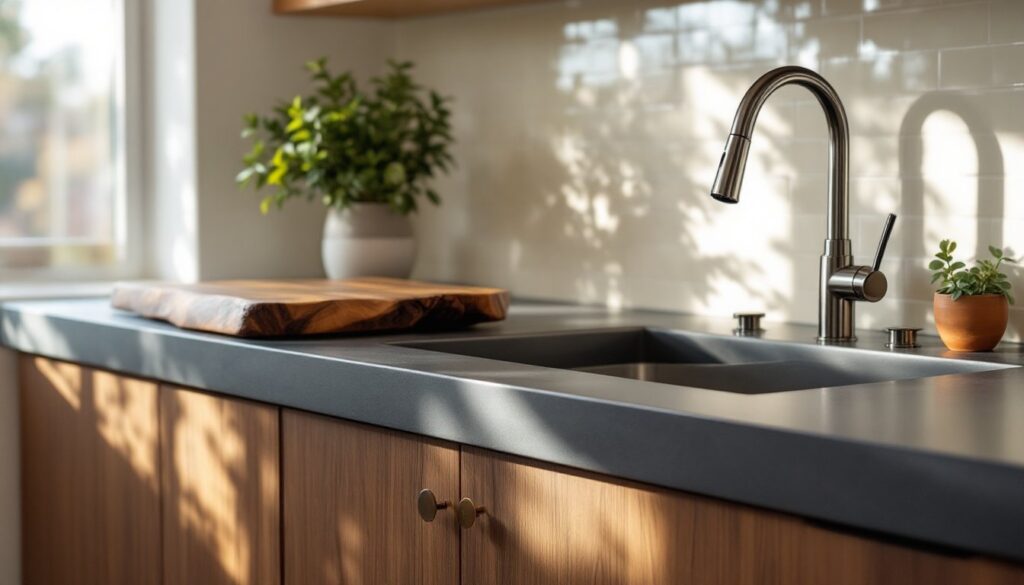
Concrete countertops deliver a modern, industrial aesthetic with near-limitless customization. They’re not the gray garage floors of the past, fabricators now create surfaces rivaling natural stone in finish and detail.
Appearance and Customization
Integral pigments produce colors from soft cream to charcoal. Aggregates like crushed glass, shells, or metal shavings embed into the surface for texture. Edge profiles range from sharp modern lines to hand-troweled organic curves. Polishing reveals aggregate depth: honed finishes offer matte subtlety.
Thickness typically runs 1.5 to 2 inches for standard residential applications. Thicker slabs add visual weight but require reinforced cabinetry, concrete weighs roughly 18-22 pounds per square foot at 1.5-inch thickness.
Installation Considerations
Two methods dominate: cast-in-place (forms built on-site, concrete poured directly onto cabinets) and precast (slabs fabricated off-site, delivered, and installed). Cast-in-place eliminates seams but ties up the kitchen for a week during curing. Precast installs faster but may show seam lines on large layouts.
Reinforcement is non-negotiable. Rebar or wire mesh prevents cracking under stress. Expect a 28-day full cure before heavy use.
Maintenance and Durability
Sealing is critical. Food-safe penetrating sealers (not topical waxes) should be applied after curing and reapplied annually. Acidic foods, citrus, vinegar, wine, will etch unsealed surfaces.
Cracks can develop, especially around sinks or cooktop cutouts. Hairline cracks often add character rather than signaling failure, but wider cracks may require epoxy repair.
Cost
Precast runs $75-$150 per square foot installed, depending on finish complexity. Custom cast-in-place can exceed $200 per square foot with decorative inlays or complex edges. This positions concrete above mid-range granite but below exotic stones. Planning a broader kitchen renovation often helps balance these costs across multiple upgrades.
Recycled Glass Countertops: Eco-Friendly and Eye-Catching
Recycled glass countertops combine environmental responsibility with striking visual impact. Crushed glass, often salvaged from bottles, windows, and industrial waste, gets embedded in a binder to create surfaces that shimmer and shift with light.
Composition and Appearance
Two primary binders exist: cement-based and resin-based. Cement binders produce a matte, terrazzo-like finish with visible glass chips. Resin binders create glossier surfaces where glass appears to float within a clear medium.
Glass content ranges from 70% to 95% by volume. Higher glass ratios increase sparkle but may reduce structural integrity. Colors span the spectrum, cobalt blues, emerald greens, amber, and clear glass all mix within single slabs. Some manufacturers offer custom blends to match cabinet hardware or tile backsplashes.
Installation and Performance
Slabs install similarly to granite or quartz, fabricators template, cut, and epoxy sections to substrate. Standard thickness is ¾ inch, lighter than concrete but heavier than laminate.
Heat resistance varies by binder. Cement-based versions tolerate hot pots to around 350°F. Resin-based surfaces require trivets, direct heat above 212°F can discolor or crack the resin matrix.
Scratching resistance falls between granite and wood. Glass chips don’t scratch easily, but the binder matrix can show knife marks over time. Use cutting boards for daily prep.
Maintenance
Cement-based glass requires periodic sealing like concrete, once or twice yearly depending on use. Resin-based versions need only soap and water. Both resist stains better than marble but less effectively than quartz.
Chipping at edges can occur from impact. Most chips expose more glass beneath, maintaining visual continuity rather than showing ugly substrate.
Cost and Sourcing
Expect $50-$100 per square foot installed for standard colors. Custom blends push prices toward $125 per square foot. Brands like Vetrazzo and IceStone lead the residential market, though regional fabricators often offer competitive alternatives. Many homeowners explore these surfaces while researching broader remodeling cost guides for budget planning.
Butcher Block and Live Edge Wood: Warmth and Character
Wood countertops inject warmth and organic texture that stone and composite surfaces can’t replicate. Two distinct styles dominate: butcher block (strips of wood laminated together) and live edge (single slabs retaining natural bark edges).
Butcher Block
Traditional butcher block uses hard maple, but oak, walnut, cherry, and bamboo all appear in residential installations. Wood strips run 1.5 to 2.5 inches thick, edge-grain or end-grain orientation.
Edge-grain construction (strips laid flat) costs less and installs easier. End-grain (wood fibers facing up, like a cutting board) resists knife marks better but requires thicker material and skilled fabrication, expect 50-75% higher costs.
Wood moves with humidity. Proper acclimation, letting slabs adjust to the kitchen’s environment for at least 72 hours before installation, prevents warping. Anchor with figure-eight fasteners or L-brackets that allow seasonal expansion.
Live Edge Slabs
Live edge countertops preserve the tree’s natural contour, bark inclusions, and grain irregularities. Walnut, maple, and local hardwoods dominate. Slabs typically run 2 to 3 inches thick to minimize cupping.
Sourcing matters. Kiln-dried slabs (moisture content below 8%) prevent cracking. Air-dried wood needs additional shop time to stabilize. Expect to pay $100-$300 per square foot for kiln-dried, flattened, and sanded slabs, plus installation.
Epoxy fills voids, cracks, and bark pockets. Clear epoxy maintains natural aesthetics: tinted epoxy creates contrast. Over-pouring and sanding flush produces glass-smooth surfaces.
Maintenance Realities
Oil or seal, the choice defines performance. Food-safe mineral oil penetrates wood, requires monthly reapplication, and allows the surface to function as a cutting board. Polyurethane or conversion varnish seals the surface, reducing maintenance to occasional cleaning but eliminating the cutting-board function.
Water damage happens. Wipe spills immediately. Standing water around sinks darkens wood and can delaminate butcher block joints. Undermount sinks minimize this risk but require careful waterproofing during installation.
Dents and scratches accumulate, that’s part of wood’s character. Light sanding with 220-grit paper removes most surface damage. Deep gouges require more aggressive sanding and re-oiling.
Cost
Standard maple butcher block runs $40-$80 per square foot installed. Walnut and exotic hardwoods push toward $100-$150. Live edge slabs start at $150 and climb steeply for book-matched pairs or highly figured wood.
Unexpected Materials Making Waves in 2026
Beyond the established alternatives, several materials once relegated to commercial or niche applications are crossing into residential kitchens.
Stainless Steel and Metal Surfaces
Stainless steel countertops bring professional kitchen performance home. Type 304 stainless (18% chromium, 8% nickel) resists corrosion and heat to 1400°F, set hot pans directly on the surface without worry.
Finishes range from mirror-polished to brushed to matte. Brushed (#4 finish) hides scratches and fingerprints better than polished surfaces. Matte finishes offer contemporary aesthetics but show water spots.
Gauge matters. Residential countertops typically use 16-gauge (0.0625-inch thick) or 14-gauge (0.078-inch thick) steel. Thinner gauges dent from heavy impacts: thicker gauges drive up cost and weight.
Fabrication includes welded seams, integrated sinks, and backsplashes. Marine-edge profiles (slightly upturned edges) contain spills. Undermount installation over plywood substrate prevents drumming noise when setting objects down.
Downsides: Stainless scratches easily, professionals call it “patina,” but some homeowners find it unsettling. Costs run $75-$200 per square foot installed depending on gauge and fabrication complexity.
Copper and zinc offer warmer metal tones. Both develop patina over time, copper shifts from salmon pink to brown to verdigris green: zinc ages to matte gray. Acidic foods accelerate patina development. Expect $100-$250 per square foot for custom metal work.
Paper Composite and Resin-Based Options
Yes, paper. Paper composite countertops (brand name: Richlite, PaperStone) laminate layers of paper with phenolic resin under heat and pressure. The result: dense, non-porous surfaces that feel closer to stone than paper.
Composition and Performance
Paper composites use FSC-certified paper (often recycled) with petroleum-free or partially bio-based resins. The material machines like hardwood, fabricators use standard woodworking tools for cutting and shaping.
Non-porous construction means no sealing required. Stain resistance exceeds wood and rivals quartz. Heat tolerance reaches 350°F for brief contact, hot pans won’t scorch but may discolor over time. Light sanding with 400-grit paper removes most heat marks.
Thickness runs ½ inch to 1.5 inches. Thinner sheets work for overlays on existing counters: thicker slabs provide structural countertops. Many resources like design-focused sites have begun featuring these materials in small kitchen makeovers.
Appearance and Feel
Matte black and slate gray dominate color options, though browns and custom colors exist. The surface feels smooth and slightly warm to the touch, not cold like stone. Over time, the material develops a soft patina similar to soapstone, which many users find appealing.
Scratches and dents occur but blend into the matte surface. Unlike wood, paper composite won’t splinter or delaminate from moisture.
Cost and Availability
Paper composite runs $50-$100 per square foot installed, competitive with mid-range granite. Material availability has expanded: most countertop fabricators now work with it, though fewer stock it than quartz or granite. Those researching eco-conscious options will find detailed comparisons in guides on paper composite performance.
Resin-Based Solid Surfaces
Acrylic and polyester resins blended with minerals create solid-surface materials (brands: Corian, Staron, Wilsonart Solid Surface). These have been around since the 1960s but continue evolving with better colors and fabrication techniques.
Seamless installation is the main draw. Fabricators thermoform and chemically bond joints, creating invisible seams. Integrated sinks and backsplashes mold directly to countertops.
Repairable surfaces matter to some homeowners, scratches, burns, and stains sand out with fine-grit abrasives. DIY repairs are feasible for minor damage.
Heat sensitivity is the weakness. Solid surfaces melt or scorch above 275°F. Always use trivets. Costs run $40-$100 per square foot installed, lower than most alternatives discussed here but higher than laminate.
Safety Note for All Materials
Regardless of material choice, installation often involves heavy lifting (granite, concrete), power tools (circular saws, routers), and adhesives (epoxy, construction adhesive). Wear cut-resistant gloves, safety glasses, and dust masks rated N95 or better when cutting or sanding. Many countertop installations are best left to professionals, templating, cutting sink openings, and ensuring level installation on out-of-square cabinets requires experience and specialized tools.