



Table of Contents
ToggleChoosing flooring for a home office isn’t quite the same as picking something for your living room. An office sees heavy chair traffic, dropped pens, coffee spills, and the occasional printer mishap. That’s why many homeowners are turning to commercial-grade flooring solutions originally designed for businesses, materials built to handle real workday abuse while still looking sharp. Whether someone’s converting a spare bedroom or finishing a basement workspace, commercial flooring options offer durability and style that residential products often can’t match. Here’s a breakdown of the top commercial office flooring ideas that work just as well at home.
Key Takeaways
- Commercial office flooring ideas prioritize durability with thicker wear layers (20-mil for luxury vinyl) and extended warranties compared to residential products, making them ideal for high-traffic home workspaces.
- Luxury vinyl plank offers the perfect balance of style and durability for home offices, featuring click-lock installation, moisture resistance, and convincing wood or stone aesthetics without breaking your budget.
- Polished concrete floors deliver modern industrial appeal with exceptional durability and low maintenance, though they require professional grinding and may benefit from anti-fatigue mats and acoustic treatments.
- Carpet tiles provide flexible, easy-to-install flooring with acoustic benefits that reduce noise during video calls, allowing spot replacement and reconfiguration to adapt your office layout over time.
- Engineered wood combines executive aesthetics with practical advantages over solid hardwood, including better moisture stability and compatibility with concrete subfloors common in basements.
- Budget-conscious alternatives like sheet vinyl, laminate, and rubber flooring deliver commercial-grade performance at lower price points, allowing you to apply premium materials selectively in high-traffic zones.
Why Commercial-Grade Flooring Makes Sense for Home Offices
Commercial flooring products are engineered for high-traffic environments, think lobbies, retail spaces, and corporate offices where hundreds of feet shuffle across the surface daily. That same durability translates perfectly to a home office, especially one that sees daily use.
Most commercial flooring carries a wear layer rating significantly thicker than residential counterparts. For instance, commercial luxury vinyl typically features a 20-mil wear layer compared to 12-mil in residential products. That extra thickness means better scratch resistance under rolling chairs and file cabinets.
Another advantage: warranty coverage. Commercial products often come with 10- to 20-year warranties that cover not just manufacturing defects but also wear-through and staining. Some manufacturers even offer lifetime residential warranties when their commercial products are installed in homes.
Commercial flooring also tends to meet stricter flammability and slip-resistance standards. Products rated for commercial use often comply with ASTM E648 (critical radiant flux) and ASTM D2047 (static load resistance), which matters if the home office is in a rental property or a space that might later be used for business purposes requiring insurance compliance.
Luxury Vinyl Plank: The Perfect Balance of Style and Durability
Luxury vinyl plank (LVP) sits at the top of most contractors’ recommendation lists for home offices, and for good reason. It mimics hardwood or stone convincingly while standing up to chair casters, foot traffic, and moisture without breaking a sweat.
Commercial-grade LVP typically comes in planks 6–9 inches wide and 36–60 inches long, with a thickness ranging from 5mm to 8mm. The thicker the plank, the more stable it is over minor subfloor imperfections, important if installing over existing concrete or slightly uneven plywood.
Most LVP uses a click-lock floating installation, which makes it a solid DIY project. No glue, no nails, just a rubber mallet, a pull bar, and patience. Acclimate the planks in the room for 48 hours before installation to avoid expansion gaps later. Leave a ¼-inch expansion gap around the perimeter: baseboards or quarter-round will cover it.
Look for products with a 20-mil or thicker wear layer and a rigid core (SPC or WPC). Stone plastic composite (SPC) is denser and more stable in temperature swings, while wood plastic composite (WPC) offers a bit more give underfoot. For office use, SPC edges out WPC for its dent resistance under heavy furniture.
One drawback: LVP can feel cold underfoot. Pairing it with an office design focused on productivity often includes adding a low-profile area rug under the desk zone for comfort.
Polished Concrete Floors for Modern Industrial Appeal
Polished concrete has jumped from warehouses and galleries into home offices, especially in modern or industrial-style spaces. It’s brutally durable, low-maintenance, and pairs well with minimalist furniture and exposed ductwork.
Polishing concrete involves grinding the surface with progressively finer diamond abrasives, then applying a densifier and sealer. The result is a smooth, reflective surface that resists stains, moisture, and wear. For a home office, a grind level of 400–800 grit delivers a satin finish that’s not too glossy but still easy to clean.
If starting with an existing concrete slab (common in basements or slab-on-grade homes), the process is straightforward: repair cracks with epoxy, grind, densify, and seal. Expect to rent a planetary grinder (around $150–$250 per day) or hire a contractor: this isn’t a hand-tool job. Polishing typically costs $3–$8 per square foot for a basic grind and seal, higher for decorative scoring or staining.
Concrete floors are hard and cold, which can be tough on feet and dropped items. Use anti-fatigue mats in standing zones. They also amplify sound, important to consider if the office is above living spaces or in a shared home. Adding acoustic panels or a ceiling treatment helps.
For inspiration on how businesses integrate polished concrete, concrete office flooring galleries showcase a range of finishes and design approaches. Radiant floor heating can be embedded in new pours, turning a cold surface into a comfortable year-round workspace.
Carpet Tiles: Flexible and Practical Office Flooring
Carpet tiles (also called modular carpet) are a commercial staple for good reason: they’re easy to install, replace, and reconfigure. Instead of rolling out broadloom and hoping for the best, tiles let someone tackle an office floor in an afternoon with a utility knife and a straight edge.
Most commercial carpet tiles measure 18×18 inches or 24×24 inches and install with either peel-and-stick adhesive or releasable tackifier. The latter allows for easy removal and replacement if a tile gets stained or worn, just pop it out and drop in a new one. Always order 10% extra for future repairs: dye lots shift over time.
Look for tiles with a dense, low-loop pile or cut-pile with high face weight (at least 24 oz. per square yard). Loop pile resists snagging from chair wheels, while cut pile offers a softer feel. For offices, nylon fiber is the workhorse, resilient, stain-resistant, and available in commercial grades rated for Class 33 (heavy commercial traffic) per EN 685 standards.
Carpet tiles provide acoustic benefits that hard surfaces can’t match, absorbing sound and reducing echo, critical in video call-heavy workspaces. They also pair well with built-in office cabinetry by softening the overall room acoustics.
One consideration: carpet requires regular vacuuming and occasional deep cleaning. For allergy-prone individuals, hard-surface flooring is usually a better call. But for comfort, noise control, and ease of installation, carpet tiles are tough to beat.
Hardwood and Engineered Wood for Executive Style
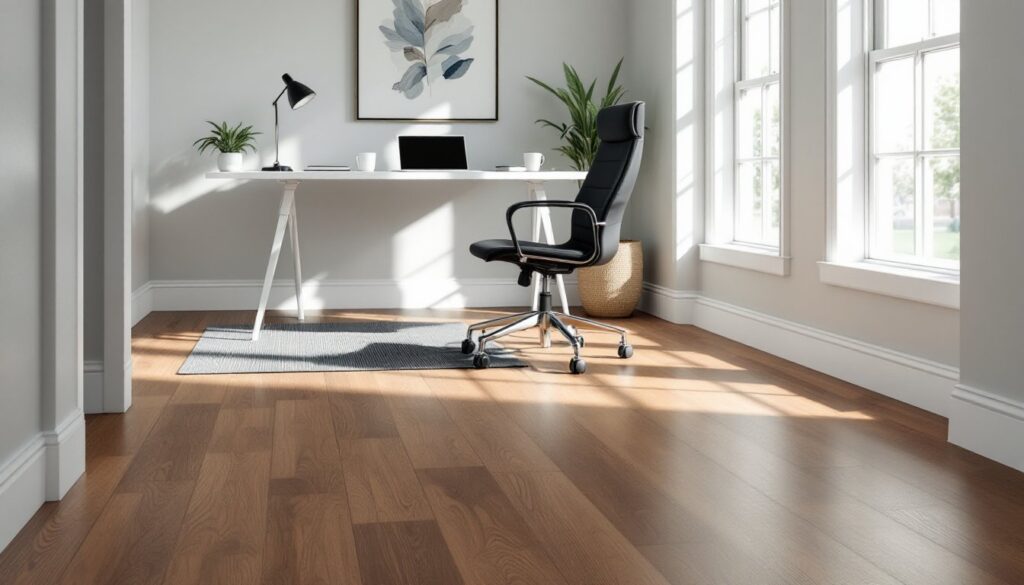
Nothing says “executive office” quite like hardwood floors. Real wood brings warmth, character, and a timeless look that works in traditional, transitional, and even modern spaces. But for a home office, engineered wood often makes more sense than solid hardwood.
Engineered wood consists of a real wood veneer (typically 2–6mm thick) over a plywood or HDF core. This construction makes it more dimensionally stable than solid wood, especially in basements or rooms with fluctuating humidity. It also allows for floating or glue-down installation over concrete, which solid ¾-inch hardwood can’t accommodate without a plywood subfloor.
For office use, choose 3/8-inch to ½-inch thick planks with a 4mm wear layer. Thicker wear layers allow for future sanding and refinishing, extending the floor’s lifespan. Species like white oak, hickory, or maple offer superior hardness (Janka ratings of 1,290 to 1,820) compared to softer species like pine or cherry.
Prefinished engineered wood saves time and mess. Factory finishes, usually aluminum oxide or UV-cured urethane, are harder and more durable than most site-applied finishes. Expect to pay $6–$12 per square foot for quality engineered planks, plus installation if not DIYing it.
Protect wood floors in office settings with chair mats rated for hard surfaces or felt pads on all furniture legs. Rolling chairs without mats will dent and scratch even the hardest woods. Maintain humidity levels between 35–55% to prevent gapping or cupping, especially in climates with dry winters.
For those planning a complete office redesign, hardwood provides a neutral, upscale foundation that supports nearly any furniture style or color palette.
Budget-Friendly Commercial Flooring Alternatives for Home Offices
Not every home office renovation has a premium budget, and that’s fine, several commercial-grade options deliver performance without the price tag of hardwood or polished concrete.
Sheet vinyl (not to be confused with luxury vinyl plank) is the workhorse of commercial kitchens and healthcare facilities. It’s 100% waterproof, easy to clean, and available in 6- or 12-foot-wide rolls that minimize seams. Installation requires a smooth subfloor and contact adhesive, making it a moderate DIY project. Costs run $1–$3 per square foot for commercial-grade products. The downside: it lacks the visual appeal of plank or tile formats, though modern sheet vinyl prints have improved significantly.
Laminate flooring offers a wood or stone look at a fraction of the cost. Commercial-grade laminate features an AC4 or AC5 abrasion rating, suitable for heavy residential or light commercial use. It’s not waterproof (though water-resistant options exist), so spills need prompt cleanup. Laminate installs similarly to LVP with a click-lock system and costs $2–$5 per square foot. Use it in above-grade offices: basements are better served by waterproof materials.
Rubber flooring, the kind seen in gyms and commercial kitchens, also works for home offices, especially standing-desk setups. It’s resilient, quiet, and available in tiles or rolls. Commercial rubber costs $3–$6 per square foot and installs with adhesive. The industrial look won’t suit every aesthetic, but for modern or utilitarian spaces, it’s practical and long-lasting. Design inspiration from home decor platforms can help visualize unconventional flooring in residential contexts.
For those exploring various flooring materials, mixing materials can stretch a budget, commercial-grade flooring in the high-traffic office zone, with less expensive options in hallways or adjacent spaces.
Conclusion
Commercial flooring in a home office isn’t overkill, it’s smart planning. Whether opting for the versatility of luxury vinyl, the boldness of polished concrete, the practicality of carpet tiles, or the elegance of engineered wood, commercial-grade materials handle the demands of daily work better than most residential products. Budget, style, and the room’s specific conditions (moisture, subfloor type, noise concerns) all play a role in the decision. For additional design ideas, resources like Homedit offer galleries and guides to help visualize the finished space. With the right material and proper installation, a home office floor can look great and perform flawlessly for years.